Friday, August 16, 2013

The Baby Faced Destroyer vs the World

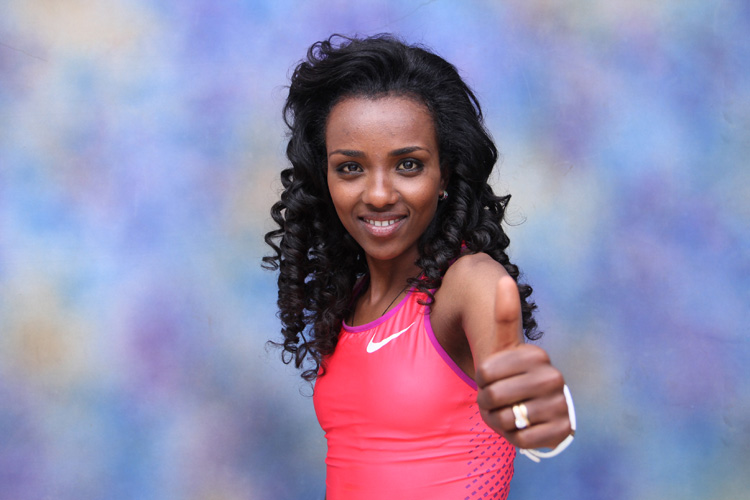
Tirunesh Dibaba doesn't sleep. She waits.  Tirunesh Dibaba can make a Happy Meal cry.  Tirunesh Dibaba can do a wheelie on a unicycle.  There are more fun facts, but we must move forward. Let's talk about the Baby Faced Destroyers (a nickname given to Dibaba because of her girlish looks) final 400 meters of the 10k this past weekend.  It was 59.96 seconds.  I need to reiterate that.  It was 59.96 seconds.  Maybe Dibaba was giving homage to Rudyard Kipling because that last sixty seconds or so was...unforgiving.  Tirunesh, the Ethiopian, took the lead with about 500 meters left to go and put 13 seconds on the previous race leader before the finish line.  It is safe to say Dibaba, who is five-for-five in World Championship or Olympic 10k's, is the model for which elite level track athletes, especially women, must look to exemplify.  Her, with her compatriot Meseret Defar, are rewriting the history books of womens distance running.


All is well when you can be a sprinter in a distance race.

There was a man almost fifty years ago who did something special in the city of Tokyo, Japan.  He was an American citizen as well as a fantastic distance runner. The gentleman, on cold and rainy October day, did what no American had done before nor has done since; Bob Schul won the 5000m at the Olympics.  A soaked and muddied cinder track could not hinder Schul from finishing the last 300 meters in a mercurial 38.7 seconds.  This was not the mondo tracks of today which are far faster, nor did he have the latest three ounce spikes, nor were the conditions prime for a fine performance.  Considering, the time is mind boggling.  There was also a curious man behind the scenes in the success Schul enjoyed that autumn eve.  A former Hungarian named Mihaly Igloi whose training program was rife with the stuff dreams are made of: hard, dirty work.  That work also happened to include really fast running.

David Rudisha puts his running shorts on the same way as you, one leg at a time.  Only when Rudisha wears his running shorts, he wins gold records.  David is a speedy fellow, clocking in the 400 at a modest 45.13 as well as being the only man to crack 1:41 in the 800 meters.  He is actually so fast, he set the world record in a non-rabbited race.  This race is what we like to call the Olympics and rarely are distance world records set there anymore.  Mr. Rudisha ran his first 200 meters in London in 23.4 seconds.  I'm going to let that sink in for a minute.  It is a shame David is injured at this World Champs and I still hope in the near future we get the Bolt vs Rudisha match-up, although I feel we might need to see a 450-500 meter race to make it even.

I hope you can follow the narrative.  Whether it was the 60's or the new millennium one thing has separated those at the top from those at the bottom: the ability to simply run faster than the competition when they needed to.  After you have your "duh" moment, think about it again.  When the Baby Faced Destroyer won the 10k this past weekend she did it looking like a sprinter who wandered out on the track after the rest of the field had done twenty-four laps.  I really enjoyed Hitomi Niiya's tenacity and wished strongly for her to medal after shouldering the load of work the majority of the race but it wasn't to be.  And in all honesty, I'm not sure that Niiya could run a 400 all out in 59.96 much less the last lap of a 10k.  And when Rudisha is healthy he can literally run away from the field considering very few 800 runners can run the first 200 as fast as he can (and still finish).  No one negative splits 800s on the world stage so his ability to separate (and maintain an industrious pace) on the first lap is similar to Dibaba and Schul separating on the last lap.

If you haven't figured it out by now, I moonlight as Captain Obvious.  I'm probably not telling you anything you didn't already know.  So if we rehashing middle school material here, my question is this: why don't more training programs reflect this understanding of elite level performance?  A few of the US elites have figured it out, or rather, their coaches have.  From Duane Solomon (4th in the 800 at the Olympics) who trains under Johnny "The Gray Zone" Gray (a direct coaching descendant of Schul's coach, Mihaly Igloi) to Galen Rupp (Silver medal at the Olympics in the 10k) who trains under Alberto Salazar, speed is a critical aspect of training.  The ability to run a 400 faster than the field precedes the ability to run the end of a distance race faster than the field.  That statement may seem counter intuitive, but you must consider this: How difficult would it be to train for a 4 minute mile if your fastest 400 was only a 57 versus if it was a 50?  The first guy has no realistic shot, but lets say they could both end up running a 4 minute mile.  The 57 second 400 runner has far less ability to match a fast finishing kick.  And there you have the secret to maximizing your potential on the track.  Be a better sprinter than the field!

Dibaba and other runners like her such as Mo Farah have maximized their ability to run away from the field due to great sprint mechanics at the end of a race, great training preceding the race, and a confidence in themselves that has developed a killer instinct on the track.  And to further establish the point, in many races Mo Farah lines up for on the track, he doesn't have the fastest PR.  Despite winning the World Championship in the 5000 meter today in Moscow, Farah had only the 7th fastest PR in the field.  It just goes to show you, athletes who train like the Baby Faced Destroyer have a better chance to win against nearly any field because no one can touch them at the end of the race.

Lastly, if I have left you scared that you are required a certain amount of sprinter in your or you will never be a top athlete in track, there is good news.  A lot of this no longer applies to races off the track such as marathon or cross country races.  Those are usually won by the craziest runners.  But that's another talk for a another day.

Knowledge Is Power- August 16th

Continue to keep yourself in the know on the history of athletics or some interesting training articles.  Enjoy your weekend!

Article about USATF and Shannon Rowbury by Letsrun- Why it matters:  The USATF has been under scrutiny the past few years for lame leaders, bad meet protocol, and now this.  USATF may be the leader of the sport, but do they do what is best for the sport?

Womens 1500 Recap by Milesplit- Why it matters: This was the race that Rowbury wanted to be in, but never the less the USA had a medalist in Jenny Simpson and the future of American distance running (actually by now she can be considered the present) Mary Cain was also in the final.


Ancillary Training Ideas by Jay Johnson- Why it matters: I'm a fan of adding in some strength work even for runners and a lot of that comes from Jay.  Strength work keeps you healthy and can add some benefits more than just looking more toned.  Thanks a lot Jay!

Being Average by Vern Gambetta- Why it matters:  I love Vern's blog posts.  They are short and to the point.  They get you thinking.  We see people who struggle to be average all the time.  Maybe struggling to be elite is just as hard as struggling to be average?  Just something to ponder.

NSAF Rosters for Pan-American Championships- Why it matters:  Well, despite this being the "future" athletes of our sport, I had another reason for putting it up.  Congrats to Dylan Duvio of John Curtis Christian School for making the roster!  We wish you good luck!

Training To Be Your Best: August 19th-25th

Week of August 19th-25th:

Goals: As school starts to return for runners across the country, the XC season begins to ramp up.  Figure out where you want to be in November and focus on the path to get there.  Continue to hydrate and eat properly!  

Monday- 35-45 minutes easy
Tuesday- 6x800 @ Saturday Goal Pace, 400m jog recovery
Wednesday- 35-40 minutes easy
Thursday- 35 minute fartlek.  Varied pace based on 2 mile and 5k race effort. Example is 30 seconds at 2 mile race effort, 60 seconds at easy running.
Friday- 35 minutes easy, 10x strides
Saturday- 3 Mile or 5K Time Trial
Sunday- Off or up to 3 miles easy


Legend:
Easy- A pace you can handle and have a conversation at the same time. Relaxed.
Tempo Run- A distance run at a pace of 5k race pace plus 30 seconds per mile.
Strides- Not a sprint! Simply a short pickup of 50-100 meters at around 1-2 mile race pace. Full recovery.
Fartlek- A run of varied pace for varied time which can be anywhere from an easy jog to hard sprinting.
Hills- Not all out sprints, good paced effort around 5k race effort. 

Friday, August 9, 2013

Doing a Proper Warm-Up

One thing's for sure, without warming up properly you will never be able to perform to your maximum during competition.  I don't say that because it is a "coachly" thing to say.  One of the tenets of my coaching programs is that I don't offer my athletes to do anything I haven't physically done myself before.  Between warm-up, cool-downs, and workouts, everything I have them do is what I've already done to myself as the human guinea pig.

I wasn't always so clever.  When I was a sprint coach my routine was pretty dull and a little too influenced by my distance background.  My favorite sprint coach of the time was Clyde Hart because I could identify with his training style which was high volume for sprinters (coincidentally I'm not even sure my 800 runners now do as much volume as some of his 400 runners did).  I had my guys do a lap or two easy then some static stretching and drills.  Either way, when I look back, it was bad.  Then again it was my first coaching foray and I was a certainly unaware of the full dynamics of training.  Anyway, after a season which only saw one runner break 23 seconds for 200 meters (yeah, it was that bad) I decided I needed to go out and learn more about the sport.

Well during my current coaching stint at John Curtis I began to implement a more dynamic warmup.  I had basically been brainwashed by Jay Johnson of Nike.  I figured I had nothing to lose; I was coaching a team varsity team with the average age of 12 so it wasn't like I was going to be setting world records in the fall anyway.  So for a few weeks I would go out after practice and experiment with different exercises and then attempt a workout and see how I would fare.  And I learned something pretty crazy.

So here I was, doing these warm up drills, basically getting in a workout before I even began the workout, feeling pretty tired when I toed the line, yet something miraculous happened.  I would run faster than I had for the same workouts a few weeks before, even feeling less than optimal at the start.  Thinking I might be insane, I asked Micah Simoneaux to try it as well and he offered the same results.  So I slowly started to get my team on board and teach them the warm up.  I took some stuff out, added some stuff in, etc., till I felt I had come to a good medium on what was necessary.  And at first it took such a long time that our hour long summer practices were solely doing warm-up drills!  It took a lot of refining.


The warm-up is an essential part of the training program.

Well by now I'm sure you are wondering what I had done that worked so well.  So a quick overview is this: a few minutes of easy jogging followed by a set of dynamic drills that focus on loosening the hamstrings and hip flexors, and then some strides. The jogging start is pretty standard and gets blood flow to the lower body after a long day of sitting in class.  I realized the magic was in the dynamic portion of the warm-up.  Runners develop very tight hip flexors and hamstrings and think back to the injuries your runners have had in the past and I can almost guarantee that these two muscles were either directly or partially responsible.  Make sure to loosen them up well!  And finally a couple strides were in order to prepare to run well in the workout.  And that's basically it.  Our warm-up went from an hour (okay so it only took that long because I was teaching proper form) to now it's around 15 minutes for the total deal.

As a coach, you need to think outside the box, or sometimes well within it, to maximize the performance of your team.  Either way, you need to be THINKING!  Most coaches develop a training plan or steal one out of a magazine and then shut it down mentally.  Challenge yourself to learn something new each year and then watch your team flourish.

Knowledge is Power- August 9th

So continuing with our weekly series of the best articles that you need to read, here ya go!  Also, if you have any articles you think should be posted on here, feel free to submit them. Email me at vpprotraining@gmail.com.

Meet Day Protocol by Scott Christensen- Why it matters:  Reaching your potential is in a large way influenced by what you do you to prepare, mentally and physically.  Knowing what to do with your body the day of the competition is pretty much the core of sports performance.

World Championships Predictions by Athletics Weekly- Why it matters:  The World Championships happen the year before and the year after the Olympics.  It's the height of non-Olympic track and nearly as important in the track world.

Interview with Malcolm Gladwell by Runners World- Why it matters: Malcolm Gladwell is the writer of Outliers, a book which puts for the notion that practice is what separates talent.  He is a former Canadian champion runner and is one of the brightest minds in the sport.


New Doping Punishments in 2015 by IAAF-  Why it matters:  Track and Field is the purest sport still left on the earth and it has no home for cheaters and dopers.  The new 4 year ban will be a deterrent for athletes to dope, plus it will keep dopers away from the sport longer.

Iron Deficiency by Carl Valle-  Why it matters:  Iron deficiency is a major problem in sports, especially for women distance runners.  Stagnation and chronic fatigue are two attributes of iron deficiency.  In order to combat this, we need to monitor our eating!

Training To Be Your Best: August 12th-18th

Week of August 12th-18th:

Goals: The summer months are hot and trying!  You've got a few weeks before it starts to cool off.  Continue to build up the amount of training you are doing and add in some short workouts to start to get used to the workouts you will do later in the season.

Monday- 35-40 minutes easy*
Tuesday- 20 minute tempo run**, 12x strides***
Wednesday- 35-40 minutes easy
Thursday- 10x400m @ 5k race pace, Walk 100m
Friday- 35-40 minutes easy
Saturday- 10x 400m Hills****, Walk back
Sunday- Off!

* Easy- A pace you can handle and have a conversation at the same time. Relaxed.** Tempo Run- A distance run at a pace of 5k race pace plus 30 seconds per mile.*** Strides- Not a sprint! Simply a short pickup of 50-100 meters at around 1-2 mile race pace. Full recovery.
**** Hills- Not all out sprints, good paced effort around 5k race effort.

Thursday, August 8, 2013

Building the Perfect Athlete

The longer I coach in track in field the more I have respect for the amazing feats that not only my athletes achieve, but also the athletes world wide.  I've worked with distance runners, sprinters, jumpers, and throwers and have had some success with all.  Each group presents certain challenges that make coaching entertaining (as well as mentally draining).  Part of coaching is more or less trying to create a "perfect" athlete for your sport, but what does that really mean?

A few years ago I was having a conversation with a roommate about NFL players vs. world class runners like Haile Gebreselassie and Kenenisa Bekele.  His contention was that the runners were better because they had literally both pushed the limits of humanity by setting world records (by the same token this also included power lifters and other athletes who only focus on one dimension of their athleticism) and mine was that it was the NFL players because their overall athleticism superseded that of those who excelled in simply one event.  But either way it got me to thinking, who really is the best athlete, and does a perfect athlete even exist?

The answer is obviously no, by virtue of definition no athlete could ever be perfect because usually a person has to give a little in one arena to gain some in another (i.e. a soccer player has no need to put on bulk mass and upper body strength because the goal is to be quick and agile).  But if you could build a near-perfect athlete, where would you start and what would you look for?

This athlete would need to be explosive, no doubt, with quick reaction time and unrelenting speed.  A good strong frame (with necessary height) to go along with this speed would create a dynamo of power.  Agility would need to be an obvious prerequisite as many sports deal with shifty moves that can separate the contenders from the pretenders.  You would also need the endurance to outrun your competition over and over again.  This deadly combination of all things athletic would constitute the top performing human in the world.

You won't find many guys like this, mainly because top level athletes only train for their specific sports and focus on the requirements that allow them success within the sport.  But if I had to guess what this athlete would look like, I think the starting point would be Ashton Eaton.  You won't find many people who can run a 10.2 and a 4:30 mile or throw the shot put 50 feet and pole vault 17 feet.  Certainly I think guys who could be like Eaton exist within other sports.  The NFL, MLB, and NBA surely has a few.  Although none of those leagues promote the full development of a "perfect" athlete (and mainly because they don't have to).


Ashton Eaton is one of the world greatest athletes.

So how would one train to emulate the "perfect" training plan?  To physically develop themselves in a manner that exemplifies the furthest development of as many attributes as possible.  This means that the guys who only lift upper body won't qualify, nor the runners who slog miles without as much as a push-up along the way, nor could the body builders who fail to actually develop any athleticism in the gym.

To truly train to be an unconquerable stotan you must be able to lift heavy weights, sprint with ease, throw powerfully, and traverse sizeable mileage on foot with efficiency.  Is that easy?  Well of course it isn't easy.  But it isn't meant to be.  I mean, we are talking about near perfection right now.

Finally, let's come back to reality for a bit.  So not many are going to become a member of the 300 anytime soon, but there is a lesson to be had here.  Pursuit of physical and athletic excellence must be broad in scope and well planned.  You need to think about your personal limitations and how to challenge them.  Embrace parts of training you had never desired to venture before.  Quit being a one-dimensional athlete and start being a little more "perfect."